# InfluxDB v2

After every test the Speedtest Tracker can send the results to InfluxDB for long term storage or custom visualizations.

### Settings

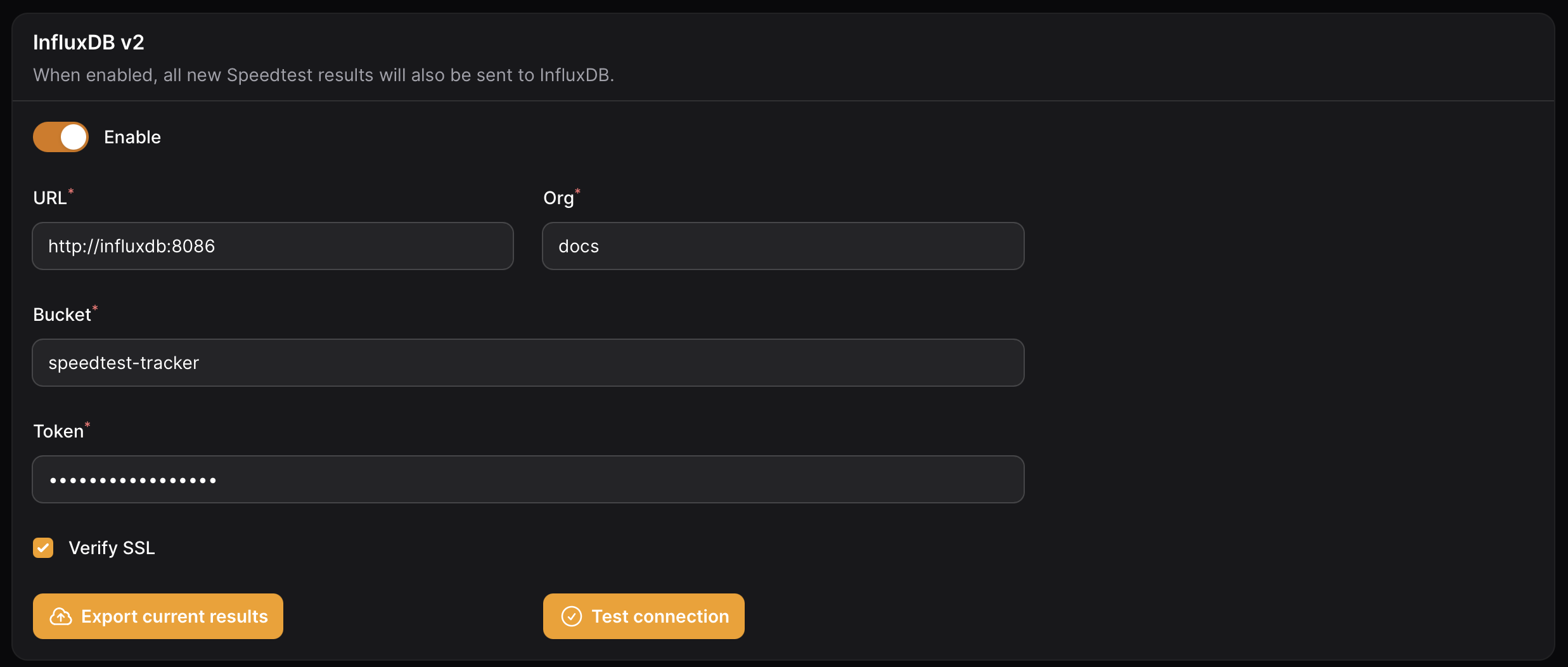
To configure Speedtest Tracker to send results to InfluxDB, set the following settings.

<table><thead><tr><th width="127.33333333333331">Name</th><th width="206">Default</th><th>Description</th></tr></thead><tbody><tr><td>URL</td><td><code>blank</code></td><td>FQDN or IP address to the InfluxDB2 instance</td></tr><tr><td>Org</td><td><code>blank</code></td><td>Organization on which you created your bucket in</td></tr><tr><td>Bucket</td><td><code>speedtest-tracker</code></td><td>The name of the bucket you created in your org</td></tr><tr><td>Token</td><td><code>blank</code></td><td>API token that has access to write to the org and bucket listed above</td></tr></tbody></table>

<figure><img src="/files/kdZTuhlULdfdCUVKnHHE" alt=""><figcaption><p>Influxdb v2 Settings</p></figcaption></figure>

If you have a history of results, you can use the `Export current results` feature to export all data to InfluxDB.

### Grafana Dashboard

You can use this community made Grafana Dashboard to visualize your data.

{% embed url="<https://github.com/masterwishx/Speedtest-Tracker-v2-InfluxDBv2>" %}

### Data pattern

The Speedtest Tracker exports data in two categories: `Tag` and `Field`. Tags are used for filtering, while fields are used for displaying the data.

<table><thead><tr><th>Name</th><th>Data Type</th><th width="100"></th></tr></thead><tbody><tr><td><code>result_id</code></td><td><code>String</code></td><td><code>Tag</code></td></tr><tr><td><code>external_ip</code></td><td><code>String</code></td><td><code>Tag</code></td></tr><tr><td><code>isp</code></td><td><code>String</code></td><td><code>Tag</code></td></tr><tr><td><code>service</code></td><td><code>String</code></td><td><code>Tag</code></td></tr><tr><td><code>server_id</code></td><td><code>String</code></td><td><code>Tag</code></td></tr><tr><td><code>server_name</code></td><td><code>String</code></td><td><code>Tag</code></td></tr><tr><td><code>server_country</code></td><td><code>String</code></td><td><code>Tag</code></td></tr><tr><td><code>server_location</code></td><td><code>String</code></td><td><code>Tag</code></td></tr><tr><td><code>healthy</code></td><td><code>String</code></td><td><code>Tag</code></td></tr><tr><td><code>status</code></td><td><code>String</code></td><td><code>Tag</code></td></tr><tr><td><code>scheduled</code></td><td><code>String</code></td><td><code>Tag</code></td></tr><tr><td><code>download</code></td><td><code>init</code></td><td><code>Field</code></td></tr><tr><td><code>upload</code></td><td><code>init</code></td><td><code>Field</code></td></tr><tr><td><code>ping</code></td><td><code>float</code></td><td><code>Field</code></td></tr><tr><td><code>download_bits</code></td><td><code>int</code></td><td><code>Field</code></td></tr><tr><td><code>upload_bits</code></td><td><code>int</code></td><td><code>Field</code></td></tr><tr><td><code>download_jitter</code></td><td><code>float</code></td><td><code>Field</code></td></tr><tr><td><code>upload_jitter</code></td><td><code>float</code></td><td><code>Field</code></td></tr><tr><td><code>ping_jitter</code></td><td><code>float</code></td><td><code>Field</code></td></tr><tr><td><code>download_latency_avg</code></td><td><code>float</code></td><td><code>Field</code></td></tr><tr><td><code>download_latency_high</code></td><td><code>float</code></td><td><code>Field</code></td></tr><tr><td><code>download_latency_low</code></td><td><code>float</code></td><td><code>Field</code></td></tr><tr><td><code>upload_latency_avg</code></td><td><code>float</code></td><td><code>Field</code></td></tr><tr><td><code>upload_latency_high</code></td><td><code>float</code></td><td><code>Field</code></td></tr><tr><td><code>upload_latency_low</code></td><td><code>float</code></td><td><code>Field</code></td></tr><tr><td><code>packet_loss</code></td><td><code>float</code></td><td><code>Field</code></td></tr></tbody></table>


---

# Agent Instructions: Querying This Documentation

If you need additional information that is not directly available in this page, you can query the documentation dynamically by asking a question.

Perform an HTTP GET request on the current page URL with the `ask` query parameter:

```
GET https://docs.speedtest-tracker.dev/settings/data-platforms/influxdb2.md?ask=<question>
```

The question should be specific, self-contained, and written in natural language.
The response will contain a direct answer to the question and relevant excerpts and sources from the documentation.

Use this mechanism when the answer is not explicitly present in the current page, you need clarification or additional context, or you want to retrieve related documentation sections.
